Accessory Report

How the right accessories transform any outfit

The Earring Equation: Matching Drops, Hoops and Studs to Your Face

2026-07-15

Quick Answer: Use contrast. Long faces balance with width — studs, wide hoops, clustered shapes. Round faces lengthen with drops and linear dangles. Angular faces soften with curves and hoops. Oval faces wear anything. Then size to your hair length, and wear one statement at a time: big earrings travel with a quiet neckline.

Earrings are the face’s punctuation. And like punctuation, placement changes the sentence — the same face reads differently with a stud, a hoop, or a long linear drop.

Most of the time this happens by accident. You buy earrings you like, some of them look great, and you never quite work out why the others sit in the dish.

There’s an actual equation underneath: geometry, hair, and restraint. Here it is.

The Earring Equation: Matching Drops, Hoops and Studs to Your Face

At a glance

What earrings suit my face shape?

One principle covers all of it: contrast the dominant line. An earring either extends the face’s lines or interrupts them, and you pick the direction that balances what’s already there.

  • Long or oblong faces — balance with width. Studs, wide or chunky hoops, clustered shapes, and short drops that sit close to the jaw. Avoid long linear dangles, which extend a line that’s already long.
  • Round faces — lengthen with vertical shapes. Linear drops, teardrops, angular dangles, and elongated hoops. Small round studs tend to echo the face shape rather than balance it.
  • Square or angular faces — soften with curves. Hoops, circles, organic and irregular shapes, and drops with rounded ends. Sharp geometric earrings amplify the angles instead of relieving them.
  • Heart-shaped faces — add visual weight at the bottom. Teardrops and chandeliers that widen toward the jaw balance a narrower chin.
  • Oval faces — the geometry lottery. Essentially everything works, so choose on scale and outfit instead.

Two adjustments worth knowing. Jaw width matters as much as face length — a strong jaw is softened by curves regardless of overall shape. And neck length affects drop length: a shorter neck is better served by earrings that stop above the jawline, since anything longer crowds the space.

None of this is a rule you must obey. It’s a starting explanation for why some pairs work instantly and others need thinking about.

Does hair length change which earrings work?

Considerably, and this is the variable people forget.

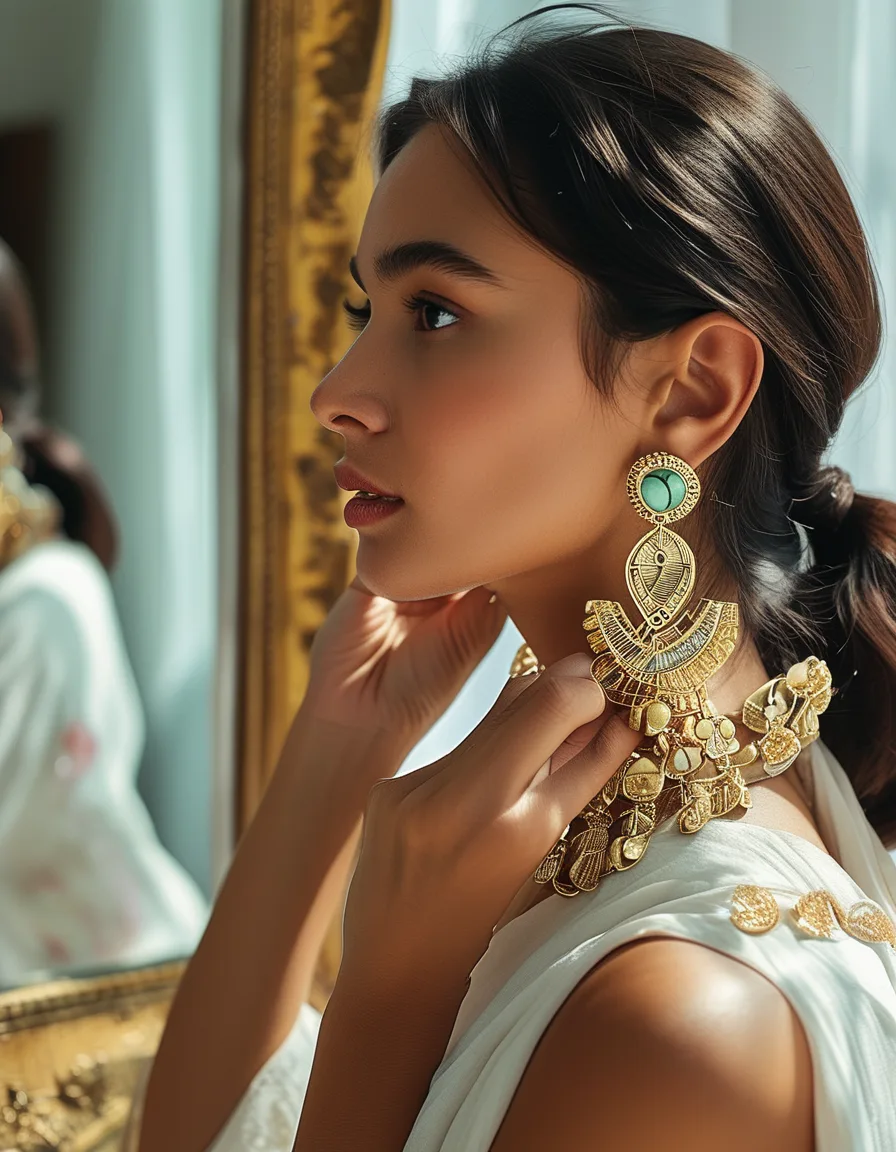
Short crops, pixies, and updos give earrings a gallery wall — clear space, full visibility, nothing competing. This is the statement earring’s natural habitat, and it’s exactly why the bob-and-big-earring combination has been reliable for a century. If you’ve recently cut your hair short and your earrings suddenly look small, that’s why.

Long loose hair swallows subtle pairs. A delicate stud simply disappears behind it. Two options: size up so the earring reads through the hair, or lean into drops long enough to peek out beneath it, which has its own kind of drama.

Hair tucked behind one ear creates asymmetry, which is worth knowing if you always tuck the same side — the earring on the tucked side does most of the visual work.

The Earring Equation: Matching Drops, Hoops and Studs to Your Face

The one-statement rule

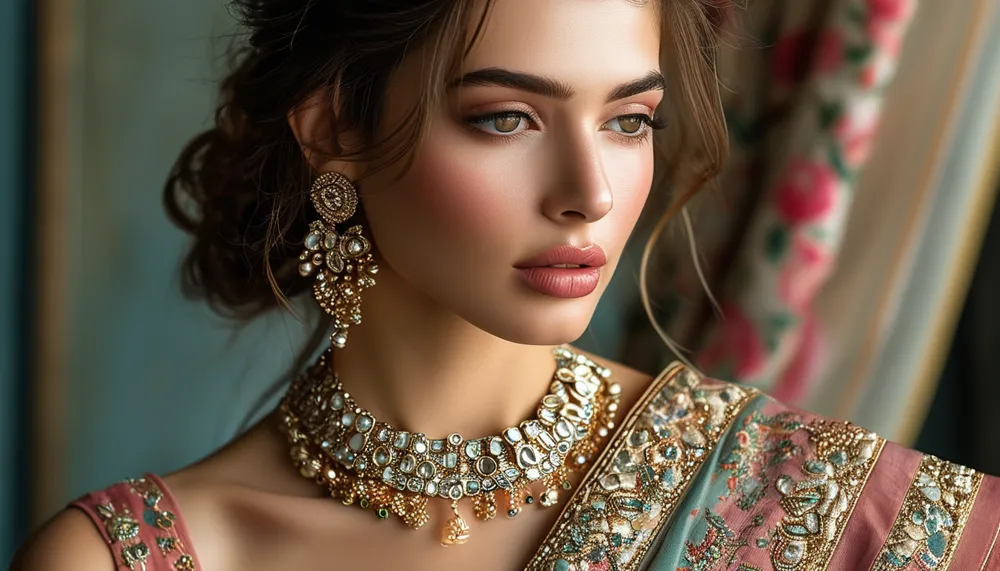
Statement ears travel with quiet necks.

A big earring and a big necklace compete for the same visual airspace — roughly the same 15 centimeters of neckline where the eye naturally lands. One of them wins by the other’s absence. It isn’t a taste rule so much as a spatial one.

The practical version: a statement earring alone elevates a plain white tee. Pair it with a chunky necklace, a scarf, a bold collar, and sunglasses on your head, and it stops being a statement and joins a crowd.

Choose your loudest piece, then make everything near it quiet. If the earrings are the event, keep the neckline simple and let the necklace sit this one out.

How it works

What Nobody Tells You

Weight determines whether you’ll actually wear them. The gorgeous pair that pulls at your lobe after two hours will live in the dish forever. Under about 10 grams per earring is the comfortable zone for all-day wear. Hollow metal construction and lightweight materials like resin or acetate let you go large without the drag.

Metal against your skin matters more than shape. If gold makes you look healthy and silver makes you look slightly gray — or vice versa — that overrides every geometry rule on this page. Test both against your face in daylight; it takes ten seconds and settles the question permanently.

Earring backs are the difference between owning and losing. Screw-backs or locking backs on anything you care about. The friction backs that come with most earrings loosen through a normal day.

Your capsule needs four pairs, not forty. Everyday studs as the default. Mid-size hoops — the most outfit-versatile shape in jewelry, working with almost everything. One statement pair, the outfit-maker. And the sentimental pair that outranks every rule here and gets worn regardless of whether it suits your face shape.

FAQ

What earrings look best on a round face?

Vertical shapes that add length — linear drops, teardrops, angular dangles, and elongated or oval hoops. They counterbalance the width of a round face rather than echoing it. Small round studs and very wide chunky hoops tend to reinforce the roundness instead.

Can you wear hoops with a square face?

Yes — hoops are one of the best choices for an angular face because their curves soften strong jaw and cheekbone lines. Medium to large rounded hoops work particularly well, while sharp geometric or square earrings tend to amplify the angles.

How do I know what size earrings to wear?

Scale to your hair and your face. Short hair or an updo leaves room for larger earrings; long loose hair needs either bigger pieces or drops that hang below it. As a rough guide, an earring wider than your jaw or longer than your chin-to-collarbone distance starts to dominate the face rather than punctuate it.

TL;DR:

  • Contrast the dominant line: width for long faces, length for round, curves for angular, anything for oval.
  • Size to your hair — short hair and updos are the statement earring’s natural habitat.
  • One statement at a time. Big earrings travel with quiet necklines.
  • Keep them under ~10g if you want to wear them past hour two.
  • Test gold versus silver against your face; metal tone beats geometry.
  • The capsule is four pairs: studs, mid-size hoops, one statement, and the sentimental one.

Keep Reading

This article is for general styling and informational purposes only. Trends, sizing, availability and pricing may vary by brand and season.

earrings face shapehoop earringsjewelry guide

← All articles